What’s out and what’s in? Workplace culture in 2025.

“Rise and grind” Bleugh.
“We’re like a family here” Sigh.
Work hard, play hard” Burnout alert.

These phrases might make you cringe – toe-curling, aren’t they? – but most of us have been guilty of saying something similar in the past.

And I’ll let us off the hook by saying, it’s really not our fault. We’re all trying our best to respond and engage with an everchanging society that has evolving expectations, technologies, wants, needs and norms. It can be difficult to keep up (no judgements here) and sometimes you just need a bit of a hand knowing what’s in and what’s out.

Now, this is not a replacement for regular CPD or training your leaders BUT… I’ve created a bit of a 2025 cheat sheet for workplace culture. Here we go:

Hustle Culture: Out.

Remember when everyone kept going on about being part of the 5am club. They’d worked out, read a self-help book, listened to a business podcast and posted about it on social media well before I, and maybe you, had got out of bed. The problem here is that while this routine may work for some, it glorifies overworking, and feeds into an idea that we’re not enough. Tony Schwartz and Eric Severson have written on this topic for the Harvard Business Review, they say that “immersion in work helps hold off feelings of inadequacy, anxiety, loneliness, sadness, and emptiness”. In effect, being busy, even to the point of being overwhelmed, helps us to stave off that crippling little voice telling us we aren’t good enough. And here’s the kicker, say the pair, “the corporate world… continues to overwhelmingly reward those who push themselves the hardest” despite the fact we know that overworking leads to burnout, poor judgement, a reduced ability to think critically, poor decision making, the list goes on. This is not to say we should discourage enthusiasm and hard work, but as employers we need to build sustainable and positive working environments demonstrated by our leaders. Does this mean you don’t press send on that email/text/WhatsApp for your team until the morning? So be it.

Quality over Quantity: In

One way to ensure your team don’t overwork, focus on outputs rather than activity. Success shouldn’t be defined in terms of presenteeism or workaholism but in efficient, quality and meaningful impact and results. Want an even bigger (and more sobering) reason as to why this must be the case in 2025? A recent World Health Organisation study found that working 55+ hours per week – compared to 35-40 hours – correlates with a 35% higher risk of stroke and a 17% higher risk of dying from heart disease.

Asking employees to bring their whole selves to work: Out

This one’s a tough one. We all meant this with the best of intentions. Post covid, we actively encouraged employees to bring all of themselves to work. We wanted to let them know that they could be authentic, true to themselves, and that they didn’t have to hide or shelter parts of their personality. And this is still true but…we can’t expect this unless we’ve fully invested in providing a psychologically safe environment, that celebrates diversity, where our workforce has received suitable, meaningful and continued learning and development that allows everyone to show up as 100% themselves. Otherwise, we shouldn’t expect too much vulnerability. Let’s not ask people to drop their guard in ways they aren’t comfortable but instead create frameworks where people feel supported in a variety of different ways. Not all of us want to let everyone in, and that’s ok.

Flexibility: In

I’m not going to say too much on this here – a lot has been said before. Only to say flexibility doesn’t necessarily mean remote working, or even hybrid. Flexibility can be just that, having the flexibility to go and do what you need to do, when you need to do it. Pick up the kids, go to a doctor’s appointment, get the boiler serviced. Life isn’t always 9-5 and we should try our best to accommodate this whenever we can.

Environmental, Social and Governance in Cumbria

Environmental, Social and Governance (ESG) activities are becoming increasingly important in attracting, retaining and empowering talent. I’d go as far to say that ESG factors are no longer optional considerations for business; recent Total Jobs research reported a 62% increase in candidate led questions around ESG commitments, with almost three quarters of job seekers reporting that they would be interested in a job that contributes to preserving or restoring the environment. And there’s no doubt employers have, to some extent, got onboard; Indeed, research reports a 116% increase in ‘green’ job postings from 2019 to 2024, and we know that 88% of publicly traded companies adopted ESG policies by 2020.

But (and it’s a big but) there’s a problem with the way ESG is embedded in many businesses. So much so that while 71% of people express interest in working for a sustainably minded employer, only 29% say Total Jobs, can correctly define green jobs from a list of options. It seems to me that businesses are often responding to candidate ‘wants’ (posting more sustainable jobs, talking about ESG in interviews etc.) without thinking about how this is translated into satisfying deep rooted candidate ‘needs’.

And to some extent, can I blame them? In the competition for talent, employers are trying to tap into the candidate psyche and meet their expectations, expectations that are being generationally challenged. If we take Gen Z for example (those born between 1997 and 2012) Deloitte report that 42% have already changed or plan to change jobs due to climate concerns. Moreover, a KPMG survey showed that 1/3 of young people have turned down a job that didn’t align to their values and in comparison to other generations, Gen Z candidates are 15% more likely to research a company’s ESG credentials. And this is before we start to think about Gen Alpha entering the workforce…

But here’s the thing, despite everything I’ve just said in terms of the importance of ESG, most people will consider ESG only after their financial and wellbeing needs are met. I don’t think that’s necessarily surprising; a base level understanding of Maslow’s hierarchy of needs theory will tell you people will always look to fulfil basic needs before more advanced needs. So, on the one hand, we need to prioritise ESG to meet candidate expectations. On the other, we know that basic needs are, and always will be, more important. How do we balance it all? What’s the answer?

We need to look to embed ESG in such a way that it becomes woven into the fabric of the employee experience. Where it’s not treated as a ‘nice to do’ but clearly and powerfully demonstrated in our everyday dealings. Some examples:

Aligning Incentives with ESG Goals – Incentives don’t have to just be attached to performance in a traditional sense. Remuneration could also be linked with meeting ESG objectives.

Recruit for Sustainability – A recent study conducted by Russell Reynolds Associates, in partnership with the UN Global Compact, found that 92% of business leaders believe that integration of sustainability issues is critical to business success, but only 4% of C-suite role specifications demand sustainability experience or mindsets.

Empowering Employees to Drive Change – Allow employees who show passion for sustainability to create their own internal networks, forums and infrastructure to contribute to ESG policy and initiatives, creating a culture of shared responsibility.

Think holistically about ESG – The S and the G are important. Often, we use ESG only to describe our environmental efforts and focus, but we need to think holistically about ESG to tie the concept back to satisfying base level needs.

Employment Rights Bill

A key element of Labour’s election manifesto was a pledge to transform workers’ rights through the introduction of the Employment Rights Bill. Last year, Labour described this Bill as “the biggest upgrade to workers’ rights in a generation” and presented a set of significant employment reforms designed to provide greater protections and security for workers across the UK.

The proposed changes represent a major shift in UK employment law, aiming to create a fairer and more balanced workplace. These reforms include a ban on zero-hour contracts, the introduction of Day One rights for unfair dismissal, Day One rights for flexible working requests, and the outlawing of exploitative fire-and-rehire practices. According to the Government, these measures are essential for fostering a more stable, productive, and equitable labour market.

Deputy Prime Minister Angela Rayner emphasised the urgency of these reforms, stating, “For too long, millions of workers have been forced to endure insecure, low-paid, and irregular work, while our economy is blighted by low growth and low productivity.” Business Secretary Jonathan Reynolds reinforced this point, adding, “Many businesses already implement worker-friendly practices and recognise the positive impact they have on retention, productivity, and job satisfaction. We want to go further—unlocking the UK’s full potential by attracting the best talent and giving businesses the confidence to hire, invest, and grow.”

At the time, I wrote about this Bill and future implications for business, but also noted the extensive period of consultation we would see across 2025 with most changes not likely to take effect until at least 2026. With the first 200 pages of amendments now published following early consultations with business groups and trade unions, I want to look at a few of the key points from the amendments and consultation responses.

Guaranteed Hours for Agency Workers

Agency workers will be covered under the ban on zero-hour contracts. Under the Bill, employers must offer contracts that reflect the hours agency workers regularly work—ensuring guaranteed weekly hours for the 900,000 agency workers currently in the UK.

In addition, agency workers will have the right to reasonable notice of shifts and any changes to their schedules. If shifts are altered at short notice, they will be entitled to compensation. This responsibility will be shared by both the employment agency and the end hirer, as either party may be responsible for providing notice.

Agency staff, like other workers, should benefit from these protections by ensuring greater stability in their working arrangements.

Statutory Sick Pay: A Day One Right

Currently, Statutory Sick Pay (SSP) is not paid for the first three days of sickness—known as ‘waiting days’—with payments starting only from the fourth day. The Bill will remove this waiting period, making SSP a Day One right.

At present, employees must earn above a set “Lower Earnings Limit” to qualify for SSP. This threshold will also be scrapped, ensuring all employees are entitled to either 80% of their average earnings or a weekly flat rate (whichever is lowest).

Collective Redundancies

Under current law, employers must hold a collective consultation if they propose 20 or more redundancies at a ‘single establishment’ and intend to make these redundancies within a 90-day period. To better ensure businesses follow these obligations, the Government is increasing the maximum protective award from 90 to 180 days, meaning employees could receive up to 180 days’ pay if their employer fails to properly consult with them during a collective redundancy process. Additionally, the criteria for triggering collective consultation will be amended—redundancy numbers will now be calculated across the entire business, rather than just a single establishment.

Bereavement Leave

Under the proposed reforms, mothers and their partners will be entitled to two weeks of bereavement leave following a pregnancy loss occurring before 24 weeks’ gestation.

Currently, parents have the right to bereavement leave if they experience the loss of a child or a stillbirth after 24 weeks. The new measures will extend this right to those who suffer a loss earlier in pregnancy.


Resilience

It ain’t about how hard you hit, it’s about how hard you can get hit and keep moving forward” said one great psychologist. No, not Freud, Jung or Erikson, but Rocky Balboa, 2006.

However you feel about Stallone as a writer, we think this dialogue quite neatly sums up the importance of resilience to the human condition. Resilience is not only critical to success, but a crucial component of happiness, satisfaction, mental and physical wellbeing. And what’s great about resilience is that it can be developed; Dr Julie Smith, clinical psychologist and best-selling author writes, “when people hit a certain life event that proves more demanding than their current coping strategies can meet, we’re learning new ways of coping, to bolster that resilience”.

It’s incredible. The ability for people to work through trauma and hardship, to live through unimaginable anguish and pain, and come out the other side. “Adversity doesn’t discriminate” says Dr Lucy Hone, resilience expert and Director at the New Zealand Institute of Wellbeing & Resilience, “if you are alive, you are going to, or have already had to, deal with some tough times”.

And yet, despite the importance of resilience, and the fact that none of us are inherently born ‘resilient’, it doesn’t get much airtime when it comes to developing this incredibly important piece of self. While it might have changed in the 20 years, we don’t remember attending any resilience classes, or being coached on strategies to handle stress in truly effective ways. What we do remember, and this might resonate with some of you, is hearing things such as “it’ll get better”, “be positive”, “you’ll get there in the end” – sentiments coming from lovely, good-hearted people, but not particularly useful in navigating the situation you’re facing at the time.

And we’re not going to talk to you about diet, sleep, and exercise – although important – because we don’t want to be one of those people who tell you to simply “go for a walk” when you’re going through sh**. Resilience is much more complex and nuanced than that. Here are some insights that have truly helped us:

I am not a victim

In times of stress, it’s easy to get caught up in feelings of victimhood. That the universe is specifically working against you and that you can’t catch a break. The danger in this mentality, of course, is that it prevents you from taking positive action (often any action) and you can spiral into a state of depression. Resilient people, Hone says, “know that suffering is part of life… and knowing this stops you feeling discriminated against when the tough times come”.

Tune out the ego

Our egos are sensitive, attention seeking, emotional, irrational, all-encompassing, energy draining and fantastic, all at the same time. The ego is uniquely wrapped up in the concept of ‘self’ – in many ways it’s the conscious part that makes you, you. But, because of this, it’s temperamental, and often prevents you from seeing things clearly and objectively. The ego is aggressively seeking out threats and in doing so is disproportionately feeding us more negative than positive. As Fredrik Imbo, in his Ted talk on ‘How not to take things personally’ says, we have 50,000 thoughts per day and yet only 10,000 are positive, that means “80% of what we think are negative thoughts”. We sometimes need to train ourselves to put our ego back in its box and look at the facts rather than our feelings.

Evaluate what’s helping/harming

It’s important to be honest with yourself and evaluate whether what you’re doing is helping you or harming you. For instance, are you exposing yourself to situations, people or experiences which are particularly triggering or stressful? Exposure to trauma, in my opinion, does not make you resilient. Instead, as Dr Smith explains, resilience is “about making lots of small changes. Reflect on what those might be, try them, keep what works, ditch what doesn’t.”


Imposter syndrome

Imposter syndrome. Have you experienced it? I have. Multiple times. We often attribute imposter syndrome and feelings of inadequacy to those early in their careers and just starting out. Newbies, finding their feet, battling the feeling that they’re out of their depth and trying their best to demonstrate that fake it ‘til you make it nonchalance that we’ve all heard so much about. However, imposter syndrome isn’t exclusive to 20 somethings, graduates, and new starters. According to research conducted in 2011, approximately 70% of people will experience imposter syndrome at some point in their lives, even in situations where they are extremely experienced and accomplished.

This makes sense on understanding that there are actually different ‘imposter types’. Dr Valerie Young, a global thought leader on imposter syndrome has categorised these into subgroups. The ‘Perfectionist’ is perhaps the most classic and widely known type, so instead and for this example, we’ll use the ‘Natural Genius’. Dr Young states in her award-winning book, The Secret Thoughts of Successful Women: And Men: Why Capable People Suffer from the Impostor Syndrome and How to Thrive in Spite of It, “Like the Perfectionist, the Natural Genius has set the internal bar impossibly high. But instead of the key measure being flawlessness, you judge yourself based on ease and speed. You expect to know without being taught, to excel without effort, and to get it right on the first attempt…. When you’re not able to do something quickly or fluently, your imposter alarm goes off”.

Does this sound like you? Maybe it does, maybe it doesn’t, but when we understand that imposter syndrome is experienced differently for different people, we realise that even the most seasoned among us can feel like a fraud. So, what can we do about it? Here are my quick-fire tips:

Reflect and Reframe: For me, imposter syndrome is usually triggered by one event. One single negative event in what could be a series of very positive events. An event that might have even been out of my control. Taking time out to reflect on the good and reframing the bad into something more workable and constructive is my go-to tactic. Focus on facts rather than feelings.

Moderate Social Media Use: Social media deserves its own special place in hell when it comes to making you feel inadequate. However great you’re doing, there’s always someone doing better, looking better, or giving you advice on how you can also earn six figures a month from the beach. Scroll with caution.

You do You: If you’re following me on LinkedIn, you’ll likely have noticed I’m not quite your ‘average’ recruiter. In fact, I’m quite confident in saying I wouldn’t fit in at a typical agency, and I’m sure they’d hate my attention grabbing TikToks, no matter how many roles I fill. But this is how I do things, it’s me, and it works, so why would I change that to fit into someone else’s mould? Be you and embrace it!

Talk it out: Sharing your feelings with those you trust can help you gain perspective and regain your confidence. I’m a big advocate for talking it out; open up and be vulnerable, you’ll feel better for it!

– Martin Norris, Head of Recruitment 

Gamified L&D

“The traditional approach to training creates opportunities to enhance long-term knowledge retention” says Abby Vietor, Global Director of Dealer Training and Productivity at Ford. With 3,000 dealerships and 164,000 employees in the US alone, Ford understand the pressures of training their colleagues in fast moving technology, products, and services. In years gone by, changes within the automotive industry were often mechanical or design led, easy to communicate and easy for the likes of sales colleagues to get to grips with. Now, we’ve entered an age of software-defined vehicles, where consumers demand enhanced technical and specialist advice when making their purchasing decisions. For Ford, this has meant moving away from traditional text-heavy L&D programmes – frankly, the level of knowledge and understanding required cannot be provided via old-style e-learning techniques. Instead, Ford and others, have moved to gamified programmes “utilizing spaced reinforcement… helping dealer employees retain what they learn… using ‘a teach, show, practice, reinforce’ framework.”

Ford have bundled this into what they’re calling the ‘Ford University’ and have onboarded award-winning producers and creatives to help develop and curate a highly engaging learning experience with AI coaching and cinematic-style resources – think big budget, Netflix style investment for their colleagues. Why? Because where once gaming was considered trivial at best (perhaps a distraction at worst) it’s generating real-world results across performance, productivity, engagement, retention and more. Last month, I mentioned that KPMG had rolled-out a gamified training tool to their employees called Globerunner…and the results were astounding. Across those offices using the tool, they saw an average of 25% fee increase, a 16% lift in new customers and 22% more opportunities.

Take from this what you will, but one thing’s for sure, we certainly can’t ignore the significance of the game-based learning market which is forecasted to be worth 29.7 billion USD by 2026. And while I’m not saying you need to invest as heavily as Ford or KPMG, it’s certainly worth considering the pros and cons to assess whether we should be starting to embed gamified training as part of our L&D programmes.

Pros

  • Gaming increases motivation, engagement, and feelings of achievement. As researcher, Bohyun Kim states, “mundane everyday activities in the nongame context turn into gaming opportunities for rewards like badges, points, rankings, and statuses.
  • Gaming provides psychological safety. Think about how many times you’ve ‘died’ in game; you leapt too far, jumped too high, made a wrong turn. It doesn’t matter, does it? Games provide psychological safety for you to make mistakes, be creative and learn.
  • Gaming provides a platform to ‘Teach, show, practice, reinforce’. Here’s the issue with traditional L&D, it’s rooted in Teach and Show but often neglects Practice and Reinforce. It tells you what you need to know, granted, but aside from perhaps a quiz at the end, that’s about it. Gaming is unique in that it provides a platform for you to use the skills you’ve learnt and enhance those skills as you continue through the game.
  • Gaming is highly customisable. Not all colleagues will require the same training, even in the same role or function. Whereas traditionally it would be time consuming to create bespoke versions of training for every colleague, gaming allows for a highly personalised experience.

Cons

  • It’s an investment. Whichever platform you choose, there’s no doubt that a move into the gamified training arena is an investment and should be considered carefully. Remember, the goal is not to be ‘cool’ or ‘trendy’, it’s to create a compelling experience that helps enable better learning by satisfying psychological needs and aligning with your values, culture, and training objectives.
  • It needs to be inclusive. Not everyone learns in the same way. Whichever programme or tool you select, it needs to be accessible and engaging to all, offering different types of gamified experiences that are inclusive, representative, and respectful of those from different backgrounds.


A reimagining of work life balance

We’re all familiar with the concept of ‘work-life balance’. In theory, it’s an enabler to people enjoying balanced lifestyles, and impacts colleague productivity, engagement, output, and retention. As a concept, work-life balance has most definitely put us on the right track; yet as hybrid and flexible working has matured and become more well practiced, I’d suggest the traditional notion of work-life balance is somewhat flawed.

For many of us, work and life are no longer mutually exclusive entities – the lines have blurred. Our changing attitudes towards work, aided by advances in technology, mean that work and life are interwoven like never before, and many of us prefer a lifestyle where work is personalised to our own wants and needs. In addition, the concept of work-life balance has often been orientated around the notion of ‘traditional’ families and isn’t always inclusive of those from more diverse backgrounds or with circumstances that are not universally applicable.

For instance, as businesses, we have provisions to cover typical circle of life events such as maternity leave, paternity leave, bereavement etc. But what about those struggling to have children? Or those trying to navigate the complexities of becoming parents for the first time? What about caring for elderly relations? What are we doing for them?

We also need to think about whether our policies are gender neutral or whether the ‘work-life’ concept has skewed these in favour of historic, societal norms. For example, Dr Jasmine Kelland, a Lecturer in Human Resource Management at the University of Plymouth, has identified what she terms the ‘fatherhood forfeit’. Her research indicates that those fathers who try to obtain roles designed to accommodate caregiving, such as part-time opportunities, are often treated discriminately and with suspicion around their pursuit of so-called, work-life balance.

So, what’s the answer? In my view, we need to reimagine work-life balance in favour of work-life integration or work-life harmony. A recognition that everyone is unique, and the goal is to allow our people to create a fulfilling life with work as a central, integrated component, whatever that looks like to them.

Martin Norris, Head of Recruitment 


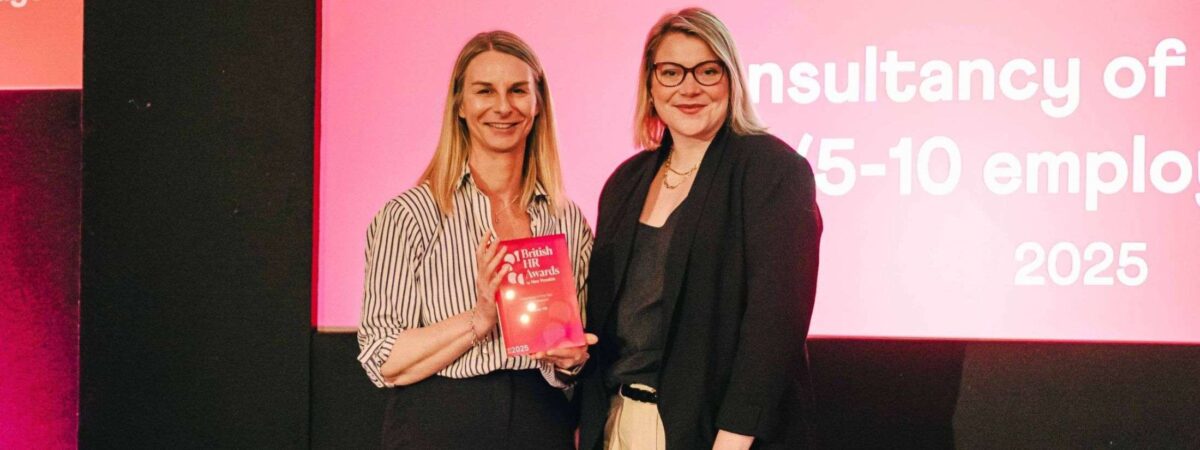
Realise HR wins HR Consultancy of the Year at the national 2024 British HR Awards

The British HR Awards is an annual campaign that sets out to discover and celebrate the organisations and individuals who are truly passionate about delivering a world-class people experience.

With just over 300 entries, this year’s competition was especially tough. Entries were received from a variety of sectors including start-up innovators, public sector heroes, tech superstars, global titans and everything in between.

Realise HR, an award-winning HR consultancy based in Carlisle, Cumbria, delivers HR solutions to organisations of varying sizes from SMEs to large corporations across the UK and Europe. Realise HR offers four support divisions: Outsourced HR-managed services to SME businesses, HR consultancy support to large organisations with people and culture-related projects, recruitment solutions in the HR, Management and Executive space and bespoke learning and development initiatives for managers and leaders.

The award win signifies a period of growth for the consultancy with recent successful tenders for a range of large organisations including pladis PLC, Lloyd Pharmacy Clinical Healthcare and Amcor plc.

Claire McLean, Founder and CEO says, “We are absolutely delighted to win this prestigious award within a very competitive field. Our team of HR specialists are dedicated to our clients and become an integral part of their team.  Winning this award showcases the commitment that our team have for both our clients and their employees. No matter the size of our clients, we pride ourselves on providing caring yet practical advice and training that creates growth for both the company and their teams.”

Nate Harwood, Founder of New Possible and British HR Awards judge said: “The British HR Awards celebrate the talented, dedicated, and passionate teams and individuals who are fuelling thriving workplaces across the UK and beyond. I’d like to extend my congratulations to all the Winners and Finalists.”


April 2024 Employment Law Update

Flexible Working Requests – a day one right, increasing to an employee being able to make two applications in a 12 month period and the removal of the requirement for employees, in their written request, to set out what effect the proposed flexibility would have on the employer’s business and how any effect could be dealt with.

Carer’s Leave (normally documented in a Time Off Policy or Family Leave Policy) – again another day one right for any employee who has a dependant with a long-term care need and wants to be absent from work to provide or arrange care for that dependant.  Employee can apply for up to one week of unpaid carer’s leave in any 12-month period and requests can be in consecutive or non-consecutive half-days or full days.

Paternity Rights – after he 6 April employees will be able to take their two-week paternity leave entitlement as two separate blocks of one week (rather than having to take just one week in total or two consecutive weeks) and at any time in the 52 weeks after birth (rather than having to take leave in the 56 days following birth).  Employees will only need to give 28 days’ notice of their intention to take paternity leave (reduced from the previous position that required notice to be given 15 weeks before the expected week of childbirth (EWC).

And in other news:

Also changing is Redundancy Protection for those on maternity, adoption or shared parental leave – did you know that for a long time anyone on such leave has the right of first refusal for any suitable alternative roles in a redundancy situation.  Well this is now being extended and here’s what changing

  • protected from the date the employee informs her employer of the pregnancy on or after the 6 April 2024.
  • employees will now be protected for 18 months from the first day of their estimated week of childbirth (EWC) and the date can be altered to starts from the child’s actual date of birth where the employer informs the employer in writing of the actual date during their maternity leave period.
  • Adoption leave – employee is Protected for the period of 18 months from the date of placement for adoption.
  • Shared parental leave –  employee is protected for 18 months from birth/placement for adoption provided that the employee has taken a period of at least six continuous weeks of shared parental leave.
  • Also where an employee suffers a miscarriage before 24 weeks of pregnancy, they will have protection during their pregnancy and for a two-week period following miscarriage. If they miscarry after 24 weeks of pregnancy this is classed as a still birth, they. They are entitled to maternity leave and will have the same protection as any other employee taking maternity leave.

If you have any questions regarding any of these changes, or require new policies to reflect these changes, please pop Becca an email at becca@realisehr.co.uk who will guide you.

A Guide to supporting Menopause in the Workplace

This guidance is intended to raise awareness about menopause, to help you foster an understanding and promote an inclusive workplace that supports everyone equally.  It is essential that employers know how to support workers experiencing menopause symptoms to ensure they meet their legal responsibilities, but also that women in this group are able to contribute to the workplace and benefit from work. 

Whilst the menopause is not a specific protected characteristic under the Equality Act 2010, if an employee or worker is put at a disadvantage and treated less favourably because of their menopause symptoms, this could be discriminative if related to a protected characteristic e.g. age, disability, gender reassignment or sex.   

All employers under the Health and Safety at Work Act 1974 stipulates an employer must, where reasonably practical, ensure everyone’s health, safety and welfare at work. 

Introduction: 

Roughly half of UK workers are women, all of who will experience the menopause, a natural stage of life that millions of women workers are either going through now or will experience in the future.  The menopause is marked by the changes in the hormones and the ending of menstruation (when a woman’s periods stop for 12 consecutive months). 

For most women it happens between the ages of 45 and 55, although some women experience it in their 30’s or earlier.  In the UK the average age for a woman to reach the menopause is 52.  During the period before the menopause (the perimenopause) these changes lead to menstrual irregularities.  There are many symptoms associated with both the perimenopause and menopause stages and every individual’s experience of the menopause will be different but some of the most common symptoms include hot flushes, palpitations, night sweats, skin irritation, sleep disturbance, fatigue, poor concentration, mood disturbance, irritability and more.  Overall, this period of hormonal change and associated symptoms can last for several years. 

The menopause can lead to changes both in physical and emotional changes which can affect both her work and her relationship with her colleagues.  It’s important we recognise workers experiencing perimenopause and the menopause and that they feel they can openly discuss this stage in their life and raise any issues or discuss any concerns, and that managers are aware of their responsibilities in acknowledging, raising awareness and supporting colleagues who are going through the menopause.   

It’s important to provide a supportive environment for colleagues experiencing menopause symptoms, which includes understanding the challenges and offering support where needed.  Those experiencing the menopause also need to know that there is someone they can go to and discuss any menopause related concerns or specific adjustments needed.

Impact: 

Workplaces can negatively influence symptoms experienced, more specifically; 

  • Work stress, and work overload, such as exceptional job responsibilities and unpredictable/ long/ inflexible working hours/ shift work. 
  • Lack of autonomy. 
  • No temperature or ventilation control. 
  • Inability to take breaks discreetly/ easily. 
  • Unwelcoming workplace environments or sexist/ ageist cultures. 
  • Standardised work wear. 

However, work can also positively influence menopausal transition in a variety of ways, such as: 

  • Provide an escape from home stresses. 
  • Social support from colleagues and workplace friendships. 
  • Increasing self-esteem and a sense of identity by being competent at work/ and or retaining financial independence. 
  • Provide positive messaging surrounding menopause and mid-later working life. 

Support: 

Colleagues experiencing the menopause need support from both the Company and their manager.  With any longstanding health-related condition this is crucial and can make a big difference to how a colleague will deal with the issues arising from the menopause.  Work can affect colleagues working through the menopause in various ways, especially if they cannot make healthy choices at work or do not have the autonomy to make changes to her working environment.   

How can Managers support: 

Managers need to be aware of the steps they can take to support colleagues experiencing the menopause. 

Some simple steps: 

  • Wait for the colleague to self-identify as experiencing menopausal symptoms – however, if you observe a colleague displaying symptoms such as hot flushes you might want to use that as an opening to a conversation and asking is there anything you can do to help make the colleague more comfortable. 
  • Prepare for a positive experience during initial disclosure – be open to discussions and approach the subject with a positive mindset, remembering it’s OK not to have all the answers during initial conversations. 
  • Work collaboratively with others as required. 
  • Offer support – allow time and space, whether the colleague is requesting an informal or formal approach, allowing for a confidential space and systematic approach that allows the colleague to raise concerns or worries and to work through those together. 
  • Develop a working plan – given each colleague’s experience is unique to them each employee may need different forms of support.  Get an idea of what they might require to improve their symptoms at work. 
  • Review the plan and support the arrangement regularly. 
  • Training Line managers about the menopause and their responsibilities to colleagues experiencing it.  Ensuring managers are clear about what support and assistance they are required to offer, including what adjustments maybe necessary to support colleagues who are experiencing the menopause. 

Training: 

There are lots of free tools and training available about the menopause to raise awareness and understanding, ensuring you can offer appropriate support and your responsibilities to colleagues experiencing it.    

Please refer to Further Support Section for guidance. 

Flexible Working: 

The Company should be committed to offering flexible modern employment practices, which recognise that all employees want to strike a sensible balance between work and their home life and that different balances maybe needed at different times during the employees’ working life. 

Line managers should be encouraged to consider flexible working arrangements to support employees experiencing menopause symptoms. 

Reasonable Adjustments: 

If menopause symptoms have a long term and substantial impact on a woman’s ability to carry out normal day-to-day activities, they may be considered a disability.  Under the Equality Act 2010, and employer is under legal obligation to consider and make reasonable adjustments and to not discriminate against the worker. 

This is where an individual risk assessment can be adopted to determine how the employee’s symptoms are impacting their ability to carry out their role and identify any reasonable adjustments that may help e.g. access to cold water, adjustment to hours, etc.  This may include an Occupational Health Referral in some cases to determine what those reasonable adjustments may look like. 

Additionally, worker experiencing menopause symptoms may be protected from less favourable treatment related to their menopause symptoms on the grounds of age and sex. 

Sickness and Absence Management Policies: 

Because the menopause can be long term and affects everyone differently, managing absence from work should be handled sensitively. 

Mangers are encouraged to keep talking to colleagues, including any performance issues which may be because of menopause symptoms, and should be prepared to look at and consider reasonable adjustments. 

Sickness absence arising because of the menopause should be recorded separately from other absences, and whilst there is no law for this type of time off, all reasonable steps should be made to allow colleagues to attend medical appointments related to the menopause. 

Risk Assessments: 

Assessments are a useful tool that help you consider the specific needs of those experiencing the menopause and ensure that that working environment will not make their symptoms worse.  This may include reviewing temperature and ventilation, uniform materials provided to employees.  Assessments should also address welfare issues such as toilet facilities and access to cold water. 

It is important to remember that workplace stress can impact menopausal symptoms, therefore stress should be risk assessed alongside concerns like temperature and access to facilities. 

Employee Assistance  

Employee Assistance Programmes can help companies create an ethos by creating an environment where colleagues feel supported.  They are intended to help employees and those living in the same household deal with personal problems that might adversely impact an employee’s performance at work as well as their life, health and wellbeing. 

Menopause and Wellbeing Champions/ or Menopause Support Group: 

If you don’t have access to an EAP system but to help promote a positive attitude to supporting those experiencing the menopause you might want to consider a support group, and or a menopause or wellbeing champion at work that can help those affected by the menopause.  From providing initial point of contact for a colleague or a safe space to talk through their concerns, especially if the employee feels uncomfortable talking to their manager in the first instance but be able to signpost colleagues to helpful resources and where they can find more information. 

Remember to treat all information related to an employee’s menopause with the utmost confidentiality. 

Further Support/ Resources: 

Useful sources of information and training links: 

NHS 

Menopause Matters 

The British Menopause Society 

ACAS – menopause at work guidance 

ACAS – training on menopause at work. 


Complete to Download

Please provide your details to access this file.